
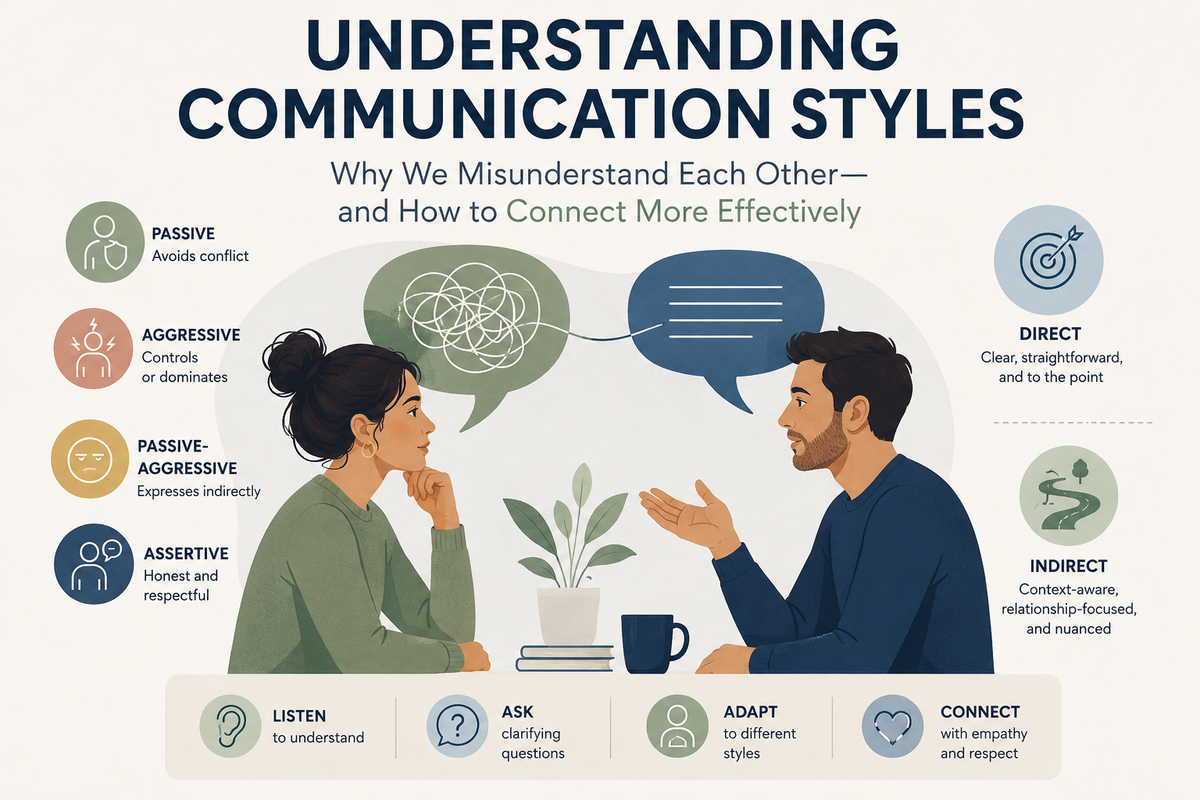
Have you ever walked away from a conversation thinking, "I explained that perfectly," only to discover that the other person understood something completely different?
If so, you're not alone.
Many communication breakdowns occur not because people are unwilling to listen, but because they communicate differently. What sounds clear and honest to one person may sound blunt or insensitive to another. What seems polite and considerate to one person may seem vague or evasive to someone else.
Communication is one of the most important skills we possess. It shapes our relationships, influences our careers, and affects how effectively we solve problems and navigate conflict. Yet few people take the time to understand their own communication style, let alone the styles of those around them.
By understanding different communication styles, we can reduce misunderstandings, improve relationships, and become more effective in both our personal and professional lives.
Why Communication Styles Matter
Many conflicts arise because we assume other people communicate the same way we do.
A direct communicator may see an indirect communicator as unclear or indecisive.
An indirect communicator may perceive a direct communicator as rude or overly blunt.
A reserved communicator may find an expressive communicator overwhelming.
An expressive communicator may interpret a reserved communicator as distant or uninterested.
Neither person is necessarily right or wrong. They are simply approaching communication through different lenses.
The goal is not to decide which style is best. The goal is to recognize these differences and adapt accordingly.
The Four Main Communication Styles
While communication exists on a spectrum, researchers and communication experts often identify four primary styles: passive, aggressive, passive-aggressive, and assertive.
1. Passive Communication
Passive communicators tend to avoid expressing their needs, opinions, or boundaries. They often prioritize harmony and may avoid conflict at all costs.
Common characteristics include:
- Difficulty saying no
- Avoiding confrontation
- Hesitating to share opinions
- Prioritizing others' needs over their own
- Seeking approval or reassurance
A passive communicator might say:
"Whatever you prefer is fine."
Even when they have a strong preference of their own.
While this style can appear agreeable, it often results in frustration, resentment, and unmet needs over time.
2. Aggressive Communication
Aggressive communicators prioritize their own goals, opinions, or needs, often at the expense of others.
They may come across as forceful, controlling, or dismissive.
Common characteristics include:
- Interrupting others
- Speaking in absolutes
- Criticizing or blaming
- Dominating conversations
- Using threats, pressure, or ultimatums
An aggressive communicator might say:
"This is the only way we're doing it."
Although this style can produce quick decisions, it often damages trust and weakens long-term relationships.
3. Passive-Aggressive Communication
Passive-aggressive communication occurs when people express negative feelings indirectly rather than addressing them openly.
Common characteristics include:
- Sarcasm
- Backhanded compliments
- Silent treatment
- Deliberate procrastination
- Indirect resistance
Examples include:
"Sure, I'll do it. It's not like I'm busy."
Or:
"No, I'm fine."
When their behaviour clearly suggests otherwise.
This style is particularly challenging because the spoken message and the underlying message do not match.
4. Assertive Communication
Assertive communication is widely regarded as the healthiest and most effective communication style.
Assertive communicators express their needs, opinions, and boundaries clearly while also respecting the needs and perspectives of others.
Common characteristics include:
- Clear and direct communication
- Active listening
- Healthy boundaries
- Respectful disagreement
- Confidence without hostility
An assertive communicator might say:
"I understand your perspective, but I see it differently."
Or:
"I'd like to help, but I don't have the capacity right now."
Assertiveness allows people to be honest without being aggressive and respectful without becoming passive.
A Quick Comparison of the Four Styles
| Style | Primary Goal | Typical Outcome |
|---|---|---|
| Passive | Avoid conflict | Unmet needs, resentment |
| Aggressive | Win or control | Damaged relationships |
| Passive-Aggressive | Express dissatisfaction indirectly | Confusion, mistrust |
| Assertive | Mutual understanding and respect | Healthy relationships and clear communication |
Most people don't fit neatly into a single category. We may be assertive at work, passive with family members, and aggressive when we're stressed or under pressure.
The key is not to label ourselves or others. Instead, these categories provide a useful framework for understanding how we tend to communicate and where we might improve.
Direct vs. Indirect Communication
Beyond these four styles, another important distinction is direct versus indirect communication.
Direct Communication
Direct communicators value clarity, efficiency, and transparency.
They generally say what they mean and mean what they say.
Examples include:
- "I disagree."
- "The deadline is Friday."
- "I need more information before making a decision."
Direct communication is common in many Western business environments and is often appreciated because it reduces ambiguity.
However, direct communicators can sometimes be perceived as blunt or insensitive, especially when interacting with people from cultures or backgrounds that prioritize harmony and diplomacy.
Indirect Communication
Indirect communicators often prioritize relationships, harmony, and preserving social cohesion.
Rather than stating things explicitly, they may imply meaning through context, tone, or suggestion.
Examples include:
- "Perhaps we could consider another approach."
- "That may be a bit challenging."
- "Let's revisit this later."
Indirect communication can be highly effective for maintaining relationships and navigating sensitive situations.
However, it can also lead to misunderstandings when people expect explicit communication.
Neither approach is inherently superior. Problems arise when people assume their preferred style is the only correct one.
What's Your Default Communication Style?
Take a moment to reflect on the following questions:
- Do you struggle to say no?
- Do you avoid difficult conversations?
- Do you become defensive when challenged?
- Do you express frustration indirectly?
- Are you comfortable stating your needs clearly?
- Do people often describe you as blunt or overly polite?
Your answers may reveal patterns in how you typically communicate.
Self-awareness is the first step toward becoming a more effective communicator.
Once you understand your default style, you can begin making intentional adjustments based on the situation and the people around you.
Adapting Your Communication Style
One of the biggest communication mistakes people make is assuming that effective communication is simply about expressing themselves.
In reality, communication is about creating understanding.
This means learning to adapt.
When speaking with a direct communicator:
- Be concise.
- Get to the point.
- Avoid unnecessary detail.
When speaking with an indirect communicator:
- Pay attention to context.
- Listen for what may not be said explicitly.
- Be mindful of relationship dynamics.
When speaking with a passive communicator:
- Invite their opinion.
- Create a safe environment for disagreement.
- Encourage them to express their needs.
When speaking with an aggressive communicator:
- Remain calm.
- Focus on facts rather than emotions.
- Set clear boundaries when necessary.
The most effective communicators are not rigid. They are flexible.
A Workplace Example
Imagine a manager asks an employee to stay late to finish a project.
A passive employee might respond:
"Okay, that's fine."
Even though they are frustrated and had other plans.
An aggressive employee might respond:
"No. That's your problem, not mine."
A passive-aggressive employee might agree but then work slowly, complain to colleagues, or miss deadlines.
An assertive employee might respond:
"I understand the project is important. I already have commitments this evening, but I can help first thing tomorrow morning."
The assertive response communicates honesty, respects both parties, and focuses on finding a solution.
Three Simple Ways to Improve Your Communication
1. Listen to Understand
Many people listen with the intention of replying.
Few listen with the intention of understanding.
Before responding, ask yourself:
"What is this person really trying to communicate?"
This simple shift can dramatically improve conversations.
2. Check Your Assumptions
Misunderstandings often occur because we assume we know what someone meant.
Instead of assuming, ask questions.
For example:
"Can you tell me more about what you mean by that?"
Clarification is often more effective than interpretation.
3. Practice Assertiveness
Assertiveness is a skill that can be developed.
Start small.
Express preferences.
Set boundaries.
Share your opinions respectfully.
The goal is not to become louder or more dominant. The goal is to become clearer.
Final Thoughts
Communication is much more than the exchange of information.
It is how we build trust, solve problems, influence others, and create meaningful relationships.
Understanding communication styles helps us move beyond judgment and toward curiosity.
Instead of asking:
"Why are they communicating like that?"
We can ask:
"What communication style are they using, and how can I adapt?"
The most effective communicators are not necessarily the most charismatic, persuasive, or intelligent.
They are often the people who understand that communication is a skill of adaptation. They recognize that different people process information, emotions, and relationships differently, and they adjust accordingly.
When we stop assuming that others should communicate like us, we become better listeners, better leaders, better colleagues, and better partners.
In a world filled with noise, misunderstanding, and division, the ability to communicate effectively may be one of the most valuable skills we can develop.